Goal 17
Where conventional companies see rivalry and competition, social entrepreneurs live cooperation. Find out here how this new view of the business world can turn other people’s success into your own. Because together, you can simply achieve more.
“Partnerships for the goals” – that’s Goal 17 of the United Nations Sustainable Development Goals (SDGs). Many social entrepreneurs use the SDGs as a frame of reference for their own impact: “We create new paths to education” (#4) or “our work protects life below water” (#14). Goal 17 is sometimes not quite as easy to describe, because it essentially covers all the other goals too. It includes all organizations whose work aims not only at their own success but also at the success of others, by redistributing and connecting structural or financial support – partnerships for the goals, in other words. Redistributing flows of money and resources also plays a role here, which sends a chill down the spines of old-school capitalists.
We want to put a face to Goal 17 with one example: Impact Factory startup Good24 and its supporters. Their story shows very well how partnerships come about, how other organizations benefit from them, and how things come full circle in the end.
STEP 1 – GOOD24 AT IMPACT FACTORY
In early 2020, Impact Factory’s Batch 2 begins, and one of the participating teams is called Good24. At first, the team consists of Dirk Lenz and Christian Will. They already bring decades of professional experience and want to start something new again, something meaningful. As brokers, they know the processes and background of the insurance industry well – and they want change! Their approach: fix a flaw in the system and use existing commission payments to fund positive ideas.
Dirk had the basic idea for Good24 15 years ago; today it’s a reality: “With Good24, I want to create a financing model for sustainable change. That’s not only important and good for solving our social challenges, it also brings the insurance industry the change it needs to finally show it in the right light. I think it’s time for all companies and industries to ask themselves how they can create purpose, not just maximize shareholder value. There are already great examples from many sectors, such as banking and energy – with Good24, we want to shake up the insurance industry.”
How does it work? Good24 lets users transfer their existing insurance policies into the Good24 system with just a few clicks. These contracts usually generate a commission – money that brokers receive from insurers for arranging and servicing the policies. In Germany, that adds up to more than 16 billion euros a year. Good24 distributes 100 percent of the profits from this money to fund social enterprises and lighthouse projects. A big advantage for customers is that they don’t pay any extra costs. With their decision, they effectively just redistribute existing profits generated from them. Of course, there are a few more details behind Good24’s concept. For more background, we recommend the reflecta Network interview with Dirk.
STEP 2 – PARTNERS
At the same time as Good24, two other projects start at Impact Factory: Zukunftsbauer and Goodgive.
For his nonprofit project Zukunftsbauer, Jens has been looking for alternative financing methods for some time. He’s especially interested in the tapping concept – diverting profits from existing markets to use them for impact. In other words, exactly what Good24 is trying to do in the insurance market. It’s a match. His knowledge of the social impact sector sparks another core element: the GoodCents platform. There, users can ultimately turn their insurance commissions into impact: their amounts are converted into the digital currency of the same name, “GoodCents”. They can then distribute these individually, depending on their preference for specific impact projects. On the platform, you’ll find projects such as Viva con Agua, ForTomorrow, or Tausche Bildung für Wohnen (whose founder Christine Bleks originally brought Dirk to Impact Factory!).
With her startup Goodgive, Sara brought a sustainable everyday product to market that she developed out of a personal need. From the very first pitch, she was excited about Good24 because its lever for social change is much bigger than a single product: “The tapping business model, which draws on an existing flow of money, offers endless possibilities for meaningful collaborations that let us support lighthouse projects and solve today’s social problems!” Today, she’s also part of the Good24 team.
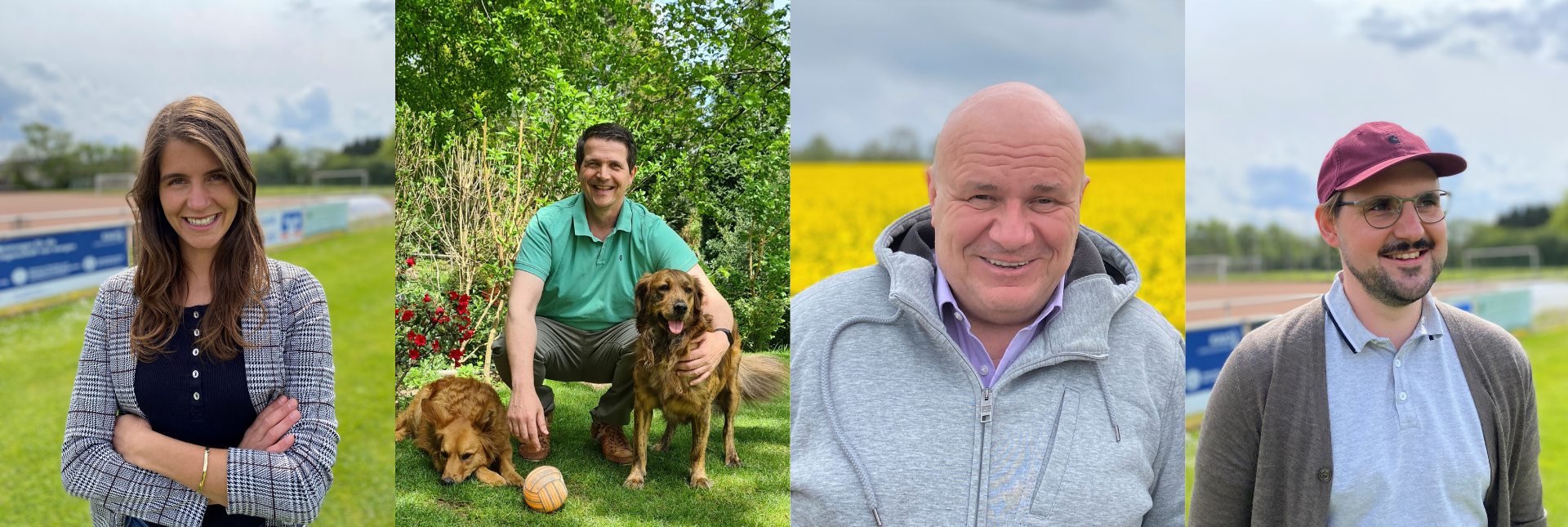
The Good24 team: Sara Stichnote, Christian Will, Dirk Lenz, and Jens Konrad. Alongside them, several other employees take care of the insurance system and the customers.
STEP 3 – IMPACT FACTORY LANDS AT GOOD24
Anyone who has already clicked through to the GoodCents platform or knows Impact Factory more closely knows that the team of the nonprofit Anthropia gGmbH is behind the workshop program. This is where the circle we mentioned at the start closes: that little g in our name means we can be supported through Good24, too.
So at this point – admittedly not entirely selflessly – we’d like to point you to the Anthropia landing page and our profile on the GoodCents platform, where every Good24 user can support us and, with us, the funding of more social startups.
But this is less about individual contributions to us and much more about how partnerships and collaborations interlock and how you – as consumers – can make an impact. Jens calls it the “democratization of profits”: “As a person, you have three big areas where you can shape things: democracy, your job, and consumption. Good24 is really a clear consumption approach, but it offers a lever to generate impact beyond simple consumption.”
Good24 isn’t alone with this idea: in our network, for example, Gexsi is competing with none other than Google by redirecting its search engine’s revenue to selected impact projects. Payactive guarantees a “social cashback” donation with every transaction in its payment system to support nonprofit projects of all kinds. And SDG 17 doesn’t always have to be about financial support: other organizations connect the right people with each other or pool and share the right knowledge to solve a problem together.
In the end, it’s about supporting projects whose success isn’t reflected 1:1 in profit but in social and environmental value. We have to ask ourselves what value (beyond the euro) we want to assign to these things. More and more purchasing decisions give you the option to have a say in this added value. Does it lie in a big player’s annual figures, or in funding socially innovative projects and climate protection? And hardly any decision should be easier than one where you don’t even have to pay extra, right? Shop [locally] impactfully!


Visit us
You'll find us at Villa Anthropia on the Haniel Campus in Duisburg-Ruhrort.