Social entrepreneurs: Crisis-proof and future-proof?
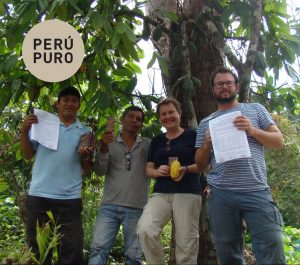
We spoke in person with Alexander Haufschild from Socialbnb and Dr. Frauke Fischer from PERÚ PURO. Alexander’s team comes from the student organization Enactus (Cologne), which supports social entrepreneurship among students worldwide. Frauke founded PERÚ PURO together with her colleague Dr. Arno Wielgoss, whom she met in her role as a lecturer in tropical ecology at the University of Würzburg. About six years ago, they decided to translate their expertise step by step into a sustainable business.
Both teams joined us when Impact Factory launched in July 2019 – which, by our standards, makes them “veterans”. We asked them about the challenges they’ve faced since the pandemic began and how they see their near future.

Can you briefly introduce yourselves? What do you do?
Alex: Socialbnb offers travelers a platform that lets them book accommodation at their destination with aid organizations and NGOs. This gives these organizations a stable source of income so they can finance themselves more and depend less on donations. At the same time, vacationers get a very special, authentic travel experience in which they get to know the country and its people up close.
Frauke: With PERÚ PURO, we use direct trade to give small farmers market access for certified organic cocoa (and coffee) from Peru, which we process and sell in various forms. Our products go far beyond standard organic certifications, actively protect the rainforest, and give cocoa farmers above-average earnings. Alongside the especially high quality of our products, our focus is on a long-term perspective for people and active biodiversity protection.
And what sets you apart from conventional competitors?
Alex: We don’t see ourselves as simple intermediaries or a service. We’re in close contact with our partner organizations and advise and support them in many ways. We don’t just offer accommodation – our project thrives on cultural exchange and our travelers’ interest in the countries and people. That creates a win-win situation: we can offer our customers a special, enriching experience and, at the same time, help give many people around the world a better future through the NGOs.
Frauke: Our credos are “more than fair” and “better than organic”. That means we pay our cocoa farmers twice the minimum organic Fair Trade price and cut middlemen out of the equation completely. We grow our cocoa in so-called agroforestry mixed cultivation. This means that our land doesn’t just grow cocoa but also other (crop) plants and, above all, up to 70 native tree species. We also actively protect 900 hectares of intact rainforest. This way of farming isn’t just ecological but also productive – alongside a variety of other crops, one hectare yields about twice as much cocoa as conventional monocultures, such as those in Ghana.
How did 2020 start for you?
Alex: Actually very well. At the beginning of the year, we had focused mainly on generating bookings and saw clearly growing numbers from January to March…
Frauke: After a lot of work, at the turn of the year we were finally able to buy equipment that lets our cocoa be processed directly at the cooperative. With additional training, this step is meant above all to give the cocoa farmers’ wives a way to contribute to their family’s livelihood. We completed the installation in February. This year, we were again able to buy more cocoa than the year before and pay the farmers an even higher price. Our chocolate production has tripled over the last three years. We were also delighted to be nominated for the German Sustainability Award 2020.
When did the pandemic reach you personally? How did you deal with it?
Alex: …until they dropped sharply shortly after. Of course, we then actively paused and also canceled bookings ourselves so as not to make the spread of infection worse. But it was strange to see how COVID was present in every corner of the world within a very short time. Our customers and followers were very interested in finding out how people in other countries were doing. So we tried organizing virtual tours of our destination countries and fundraising appeals for our NGO partners. As a company, we used the past few months to develop further. We reviewed and refined our questionnaire for possible new partnerships. In the process, we added great new projects and more than doubled our offering to over 100 destinations in 35 countries by the end of the year. In the long term, we want to broaden our target group by also offering accommodation with a bit more comfort – so we’re not just appealing to adventurers and backpackers. At the same time, we worked steadily on strategy and structures. That means fine-tuning our marketing and thinking about a visual redesign.
Frauke: We had to postpone on-site activities, like these trainings, for the time being once the lockdowns started. But since importing from Peru is fairly contact-free, we’re otherwise not very restricted in our work with our cooperatives in Peru. Things looked a bit different for us on the sales side.
Did the pandemic seriously threaten you as entrepreneurs?
Alex: As an online platform, we’re lucky to have few fixed costs at the moment. Also, as a team, we’re not (yet) financially dependent on Socialbnb. At the same time, we still have reserves from prizes at past founder competitions and the Gründerstipendium NRW founder fellowship. That gave us a lot more independence over the year. Next year, we plan to focus on revenue for the first time and convert into a GmbH so we can become economically viable in the long term. I think a situation like this would have hit us much harder a few years later.
Frauke: For us here in Germany, the main problem was that many of the more than 100 stores that sell our products had to close. Our online shop clearly helped. As a matter of principle, we’ve always done without investor money so we don’t end up in the usual profit-driven structures. Our “core business” of social and environmental progress has suffered practically no losses – on the contrary, our partner farmers came through the hard lockdowns in Peru better than almost anyone around them. We owe that largely to mixed cultivation: on the one hand, they were able to greatly reduce their contacts because they no longer needed to shop in town; on the other, their food supply was secure. Our system is much more resilient – in normal times and in times of crisis!
What are your plans for the (near) future? Where do you think things are headed?
Alex: With Socialbnb, we of course want to prove that tourism can be done differently. The industry is now facing upheaval. We want to help shape it and make sure that mindful, sustainable travel moves more into the spotlight. We believe that the enormous economic power of tourism can be used much more clearly for good causes. Our partner organizations are currently showing what that means: especially at the start of the pandemic, we saw how important they are for their local communities. They played a major role in supporting their communities, for example through medical care and education. Many were able to help their surroundings far beyond their own project. As a company, we’re now counting on 2021. We hope the situation will ease enough by spring that we can take off with our expanded travel catalog with a clear conscience. One idea for the near future is also to promote domestic tourism and reach people who want to travel in their own country. We’re now looking for multipliers to help with that.
Frauke: COVID has really only confirmed our business model. Especially now, we’re showing that nature and people are better off when we use resources more mindfully and focus on the long term. Our environment is incredibly interconnected, and biodiversity always has to be thought of holistically. Without the midge, there would be no chocolate! The cocoa plant has a very complex structure that, for example, bees can’t pollinate. That’s done exclusively by certain species of midges (by the way, you can read more about how our environment is interconnected in my current book “Was die Mücke je für uns getan hat”). Our farming model is clearly scalable and, for us, the future of cocoa farming. And on a social level, anyone who says “More than two euros for chocolate is too expensive for me” has to be aware of the consequence that someone else in the world suffers as a result. The injustices this cements have many effects, all the way to driving refugee movements.
Thank you both so much!
So does that mean everything is actually going smoothly for social entrepreneurs? No – of course we have to admit that, generally speaking, many social startups are currently facing particular challenges, especially if they’re not yet financially stable or their core business requires personal contact. The Social Entrepreneurship Network Germany (SEND) took stock in the spring. At the start of the pandemic, a core problem was that social enterprises were simply forgotten in the relief packages or fell through many cracks because they were too young or weren’t yet generating revenue. Over the year, efforts from within the sector improved the situation somewhat. The current renewed lockdown and the near future will show how effective these measures really are.
On the other hand, our interviews also prove that a fundamentally rethought, more social way of doing business helps many people – and not just in Germany – get through times of crisis better. When profit maximization isn’t the highest principle, there’s simply more left over for people and the planet.


Visit us
You'll find us at Villa Anthropia on the Haniel Campus in Duisburg-Ruhrort.