Revolution on the store shelf

- Where do the products come from?
- How are they produced?
- What system am I supporting with every purchase?
- Where does my money go?
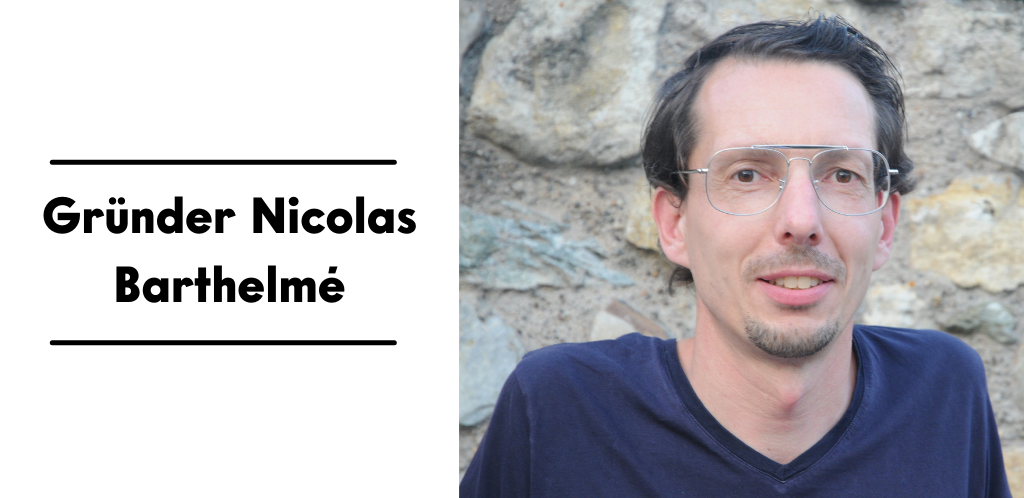
These are the four questions Nicolas Barthelmé set out to answer when he founded the initiative Du bist hier der Chef (“You’re the boss here”) almost two years ago, in June 2019. The association puts a simple idea into practice: putting the production conditions of food (back) into the hands of consumers. The concept originally comes from France, where it has already established itself very successfully.
The Du bist hier der Chef-principle starts with a public survey in which participants vote on exactly these production conditions. For the first product, the Chef-Milch, these were, for example, questions about how the dairy cows are kept, the animal feed, and how much the farmers are paid. Each option shows an exact equivalent in euros, so participants know exactly what animal welfare costs and which benefits they’re willing to pay more for. In the end, the most popular options win (spoiler: the winners are, quite clearly, especially fair conditions), and the initiative turns the chosen product into a consumer brand. In the future, this grassroots-democratic principle is to be applied to more and more staple foods; eggs and potatoes are next.
From the start, the initiative has exceeded its own goals: the 5,000 responses hoped for in the first survey turned into almost 10,000, and milk sales are growing steadily, now at more than 750,000 liters. At the same time, the public and media response is incredibly high for such a young company. Du bist hier der Chef has already featured in numerous TV segments and articles. At the end of 2020, they won the Hessian Founders’ Award, and in early 2021 a fairness award for their consumer milk. The desire for fairness and transparency is definitely there – and long overdue.
Reality check
About six months before the official launch, Nicolas looks around at an agricultural trade fair in Berlin. Dairy farmers describe a sobering situation to him: “It’s not unusual for milk to be collected from a farm without a price being set,” Nicolas sums up his conversations. “Farmers only find out at the end of the month how much they’re actually earning. At the same time, the extreme price pressure puts any thinking about the future on hold. New barns or pastures and other investments are almost impossible when they’re barely covering their costs.”
On top of that, agriculture is already feeling the effects of climate change especially clearly. One drought summer after another significantly changes the feed harvest. That means either buying feed in or giving up animals. All in all, there’s little room for quality: many are struggling with great financial uncertainty, while the overall situation in the industry keeps getting worse. Nicolas describes how one of the first 15 partner farms in Hesse was on the brink and was only able to make up for a crisis year thanks to the better pay. “Many others don’t have that chance and will have to give up.” You may know the German term “Höfesterben” – the dying-out of family farms.
City vs. countryside?
Today, this reality rarely reaches the cities. Many of us consumers have become very disconnected from where our food comes from. As so often, the motto was: as much as possible at the lowest possible prices. The extremes this leads to are simply ignored at first. The products are on the shelves, so production must be working.
Nicolas experiences the result of this disconnect even before the milk actually launches: “With our first approach of focusing on the farmers’ concerns, we pretty much hit a wall,” which surprised him too. While developing the concept, he meets quite a few disgruntled voices who don’t think much of farming as a profession: “They just destroy the soil or torment animals anyway, but still get fat subsidies,” was roughly the tone. Indirectly related scandals, such as the one in the meat industry in spring 2020, only harden this image of the food industry – and of course, not always unjustly.

Nicolas himself comes from the food industry, where he worked in marketing and sales for many years. His diagnosis is that agriculture has focused too much on producing raw goods and has kept itself completely out of processing and marketing. “This is now the bad result of that development,” he sums up. “They’ve lost access to many consumers and, with it, the chance to explain why they work the way they do.”
The solution surely can’t keep being the next scandal. For now, it’s about building understanding – and about getting back to basics. “What system am I supporting with my purchase?” as Du bist hier der Chef puts it. So the core of the conflict isn’t city vs. countryside or producers vs. consumers, but rather transparency vs. a lack of it. Nobody wants to buy unfairly produced animal products, but hardly anyone is aware of what animal welfare and sustainable farming actually cost.
Consuming with a voice
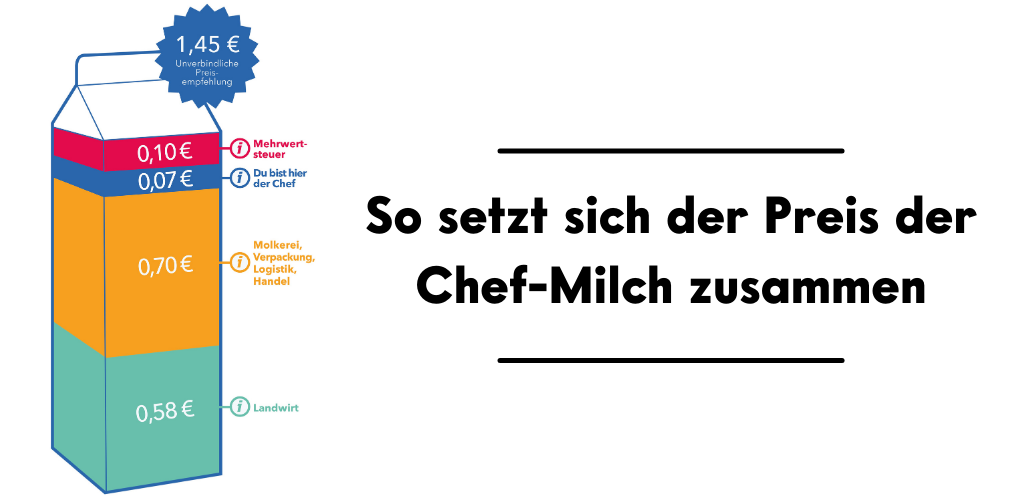
The Chef-Milch costs €1.45. That’s comparable to other branded products. The big difference ultimately lies in complete openness about the production conditions and the price of the milk. Where does my money go if I spend €1.45 instead of 80 cents? Into animal welfare, or into the margin of the brand or the retailer? At Du bist hier der Chef, it’s broken down exactly: the producers earn 58 cents per liter, more than with any other milk – organic or conventional. This guarantees a high level of animal welfare, but also the long-term survival of the farms. The rest is split between processing, retail, transport, VAT, and finally 7 cents – that is, 5 percent – for the work of the association and the producing GmbH. Nicolas sums it up: “58 cents – nobody else in the industry manages that. But for us as a small initiative, it’s made possible by the power of consumers who push our idea forward.”
That power shows elsewhere too: so far, Nicolas hasn’t spent a single euro on advertising and marketing. The association’s members spread the idea and are ultimately also the ones who get the milk into stores by asking their local supermarkets. Du bist hier der Chef thrives on participation.
“Bringing supply chains back home”
In theory, the Du bist hier der Chef principle can be applied to far more than just food. Nicolas says he could imagine tackling other goods later on. In fact, he’s already had a few such requests, for example for textile products: “I think something like that is an exciting step – in the future. Starting with food makes sense for us because our producers are right on our doorstep. With textiles, we’d have to consider whether and how we can effectively bring production back to Europe. So it would first be about reviving regional cycles.”
According to Nicolas, though, ideas like these are still clearly a thing of the future. The next step is rather to combine a range of staple foods to make further processed products. A little later, you might then find Chef yogurt or Chef pizza in the supermarket. But no matter what ends up on the shelf: Du bist hier der Chef shows us an alternative path where transparency, co-determination, and fairness come first. As consumers, it gives us the chance to recognize real added value in prices and make truly informed decisions about what we consume.
To have your say, find or suggest a store, or learn more about the initiative, visit the Du bist hier der Chef website.


Visit us
You'll find us at Villa Anthropia on the Haniel Campus in Duisburg-Ruhrort.